
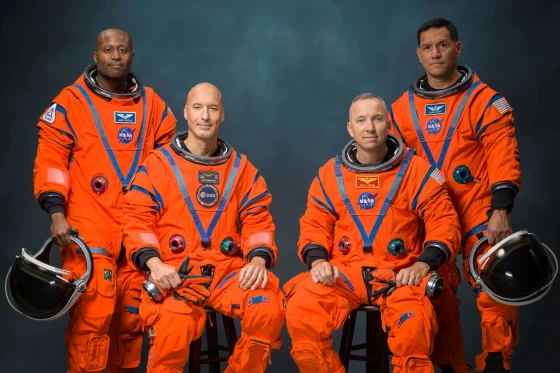
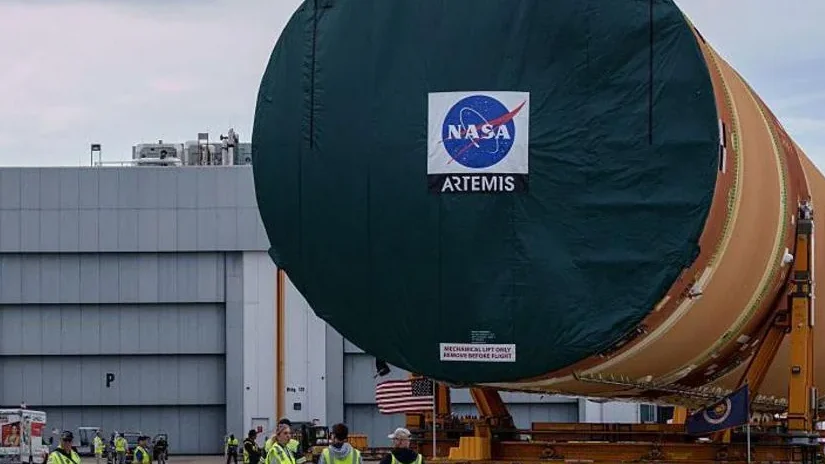
NASA officials insisted today that the plan is still to land humans back on the Moon by 2028 as part of the Artemis program, for which next year’s Artemis III launch is meant to test various components.
The private companies with which Nasa is partnering, SpaceX and Blue Origin, are way behind schedule in developing their lunar landers. SpaceX has not demonstrated its able to refuel its spacecraft in Earth orbit. And Blue Origin’s launch pad blew up last month.
But the message from spokespeople from both firms was essentially: “Don’t worry, it’ll be fine”. But they gave no explanation of how they would catch up to be ready for even prototype spacecraft by next year.
Nasa’s head Jared Isaacman proudly proclaimed from the stage in Houston today that science fact was catching up with humans’ imaginations, when he said “this seems like the beginning of Starfleet Command,” a reference to the Star Trek franchise.
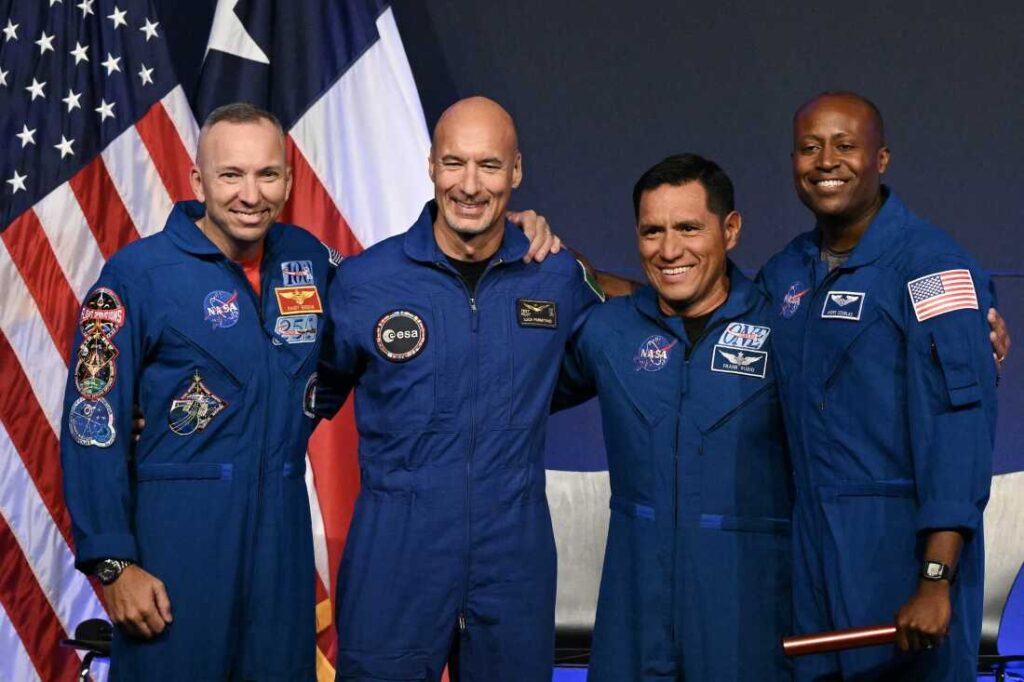
Randy Bresnik, Luca Parmitano, Frank Rubio and Andre Douglas are expected to launch into Earth orbit next year, with the goal of testing two commercially developed lunar landers that are slated to carry astronauts to the surface of the moon during the Artemis IV mission in 2028.
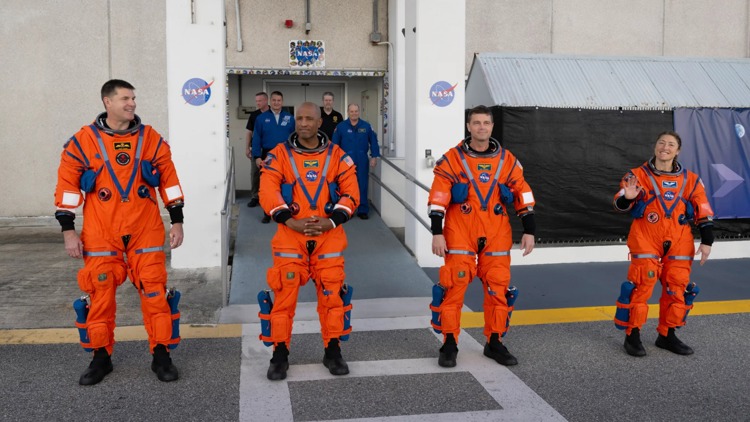
Bresnik will be the mission’s commander, with Parmitano, an Italian astronaut with the European Space Agency, serving as the pilot. Douglas and Rubio will be mission specialists, and Bob Hines will train with the crew as a backup member.
Elon Musk’s SpaceX and Jeff Bezos’ Blue Origin are racing to build the landers that Artemis III aims to test. Both companies said in updates Tuesday that they expect their vehicles to be ready.
“This test flight will enable us to prove we can carry out highly choreographed operations with our partners across hardware interfaces, software propulsion systems and life support elements with crew in the high-stakes space environment,” Jeremy Parsons, NASA’s Artemis program manager, said during NASA’s announcement on Tuesday.
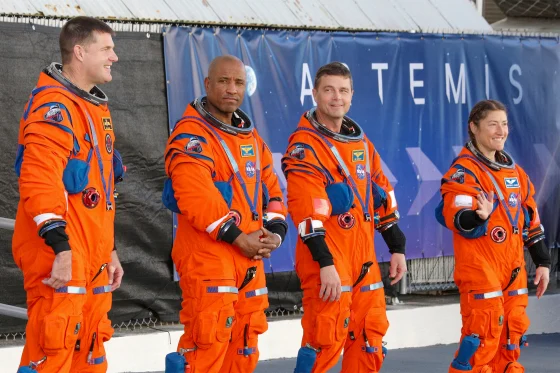
Bresnik has been to the International Space Station twice, most recently as commander of an expedition in 2017. A retired U.S. Marine colonel, he was selected as a NASA astronaut in 2004.
Bresnik has helped oversee development and testing of spacecraft for the Artemis program as an assistant to the chief of the Astronaut Office, which manages astronaut training and operations
2 comments
ekaratna
Elon Musk’s SpaceX and Jeff Bezos’ Blue Origin are racing to build the landers that Artemis III aims to test. Both companies said in updates Tuesday that they expect their vehicles to be ready.
AB BHAT
This test flight will enable us to prove we can carry out highly choreographed operations with our partners across hardware interfaces, software propulsion systems and life support elements with crew in the high-stakes space environment